Welcome to my latest blog post! It certainly has been a little while since the last one, but life has conspired against me being able to write recently. Life has been extremely busy, what with client work, tutoring work with the University of Strathclyde and I have also moved house! So all in all, a lot has been going on in the last few months.
However, I do now have some time to share my thoughts with you all again and I am very excited to do so! So what have I been up to otherwise? Well I am continuing research on my One Name Study. I read an email from the Guild of One Name Studies recently and liked how the author had described their ONS as a marathon and not a sprint. That certainly applies to mine too. After having put together a fairly complete database for Somerset Rowsell births last year (see my previous post on the subject), I have been extending that to Rowsell births for the rest of the country. To begin with, I did think about doing that after I had completed databases for Somerset marriages and deaths too, but I was on a roll and decided to keep with the births for the moment! It is going slowly but steadily, as there is quite a lot of data to deal with, but hopefully that will be complete soon. Then of course, I have to think about how to share the information with you all. GOONS does have guidance on that, so that is something else I will explore in the upcoming months.
I have also been delving further into the research I undertook for my MSc Dissertation and have been ploughing on with trying to transcribe and translate Medieval Inquisitions Post Mortem, specifically for Somerset women. Women can be an under researched group of individuals at times and the IPMs themselves certainly need a great deal of further research, as so many have not even been transcribed (let alone translated). This sadly makes them pretty inaccessible for the researcher in general, so I hope to be able to contribute (eventually!) to rectifying that situation. Sometimes you just need a catalyst to get you back into researching or thinking about a particular area again, and mine had to have been the talk I recently presented for the Foundation for Medieval Genealogy. This was based on the IPM work I have finished to date and was a great start to doing in person talks again! I am due to give the same subject to the Frome Family History Group in March next year, which I am very excited about. I met the group when I attended the Frome Family History Day back in May this year.
Some of you may remember my previous blog posts regarding one Gouly de Chaville (click here and here for a link to these posts) and the legacy of his surname. At the time of writing, there was so much more that I could have said, so I hope to write some more about him. I hope to do some more research on his grandchildren and great-grandchildren too, as there is some exciting research to be done in Australian and South African sources. One day, perhaps this might even lead to another One Name Study, but one step at a time! It will have to go in the queue behind my other idea for an ONS: Incledon. That surname is another story altogether, but it is a side of my own family that has presented quite the brick wall, so I have been wondering if an ONS approach might help.
There are of course many other things that I might be writing about as the year goes on (forgive me but I think in Academic years rather than calendar years at the moment!), but everyone has to start somewhere, especially after such a break as I have had. The other problem is that there are so many ideas to put down, that finding the time to explore them all is difficult. So in the vein of taking it step by step and starting somewhere, I will probably concentrate on the main three above. Due to time constraints, I won’t be able to post quite as much as I have in previous years, but do look out for my posts on the first week of the month.
It is very satisfying when a blog post comes together unexpectedly. All of a sudden, something sparks an idea and off you go! I had not intended to write a second instalment about the meeting of Archaeology and Genealogy, but here it is!
The beginning of an idea
The first part of this idea explored the presentations of the Society of Antiquaries Conference: Seals and the People of Britain. Out of all of the presentations, of most interest to me was Helen Geake’s Women and their Seals. A discussion of the seals catalogued by the Portable Antiquities Scheme, Helen Geake’s presentation introduced me to a further aspect of Medieval history and one that may be useful for research into Medieval ancestors. This post is a continuation of the idea of Genealogy working together with other disciplines, but this time in the area of burials.
Burials, but a different approach?
Burials are of course events that genealogists are very familiar with. They are a fundamental event that becomes even more so before the introduction of Civil Registration in 1837. Therefore, they are nothing new to genealogists and you may wonder what more I can say about them in this post?
The point I hope to make, is how we can improve our work in genealogy by considering separate, disparate aspects of research all together. The end result could then be a better understanding of not only our ancestors, but of their way of life and how they understood their world. This is something that we can then pass on to our clients, to help them better understand their own ancestors. Additionally, we might just realise how much we can learn from other historically based disciplines and how much they can learn from us.
Photo by Meta Zahren on Unsplash.
Another meeting of Archaeology and Genealogy
Earlier this month, I was lucky to get tickets to Professor Alice Roberts’ latest tour, discussing her book ‘Ancestors.’[1] I am sure you can understand the appeal for a genealogist of a title like that! I am by no means an archaeologist, but I have always found that area of historical research fascinating. In some ways, it is the polar opposite to genealogy- we examine documentary records to research our ancestors and archaeologists use objects to do the same. If you have ever watched programs like Time Team, you will know that the two are not always mutually exclusive either. Digs that focussed upon uncovering buildings or structures within written history often used documentary records to aid the investigation (where possible).
So naturally, I jumped at the chance to hear Alice Roberts speak. As you may expect from someone with her experience, the presentation was engaging and accessible, especially for those of us who aren’t so familiar with the archaeological world. I am still in the process of reading the book, but the presentation dealt with some of the subjects included within. These subjects are seven specific burials and more specifically, what they can tell us about our ancestors. Whether that is what the bones can tell us, what the grave goods can tell us, or what the DNA can tell us. The latter reminded me of Adam Rutherford’s A Brief History of Everyone Who Ever Lived,[2] which also goes to show how all of these different disciplines are interlinked; DNA research, Archaeology, Anthropology, Historical research in general and of course, Genealogy. We simply focus on different facets of the same entity.
What can genealogists learn from other disciplines?
Whilst Alice Roberts focuses upon burials from pre-history in ‘Ancestors’ (as a Somerset person, ‘Cheddar Man’ is of great interest) it got me thinking about how genealogists consider burials. As I mentioned above, we are used to using written burial records, which do not always contain a great deal of information. We then have to assess these in relation to other records to ascertain the likelihood that the record pertains to the person we are looking for. But what other techniques do we use, or even could we use?
Obviously, as genealogists we are not going to go around digging up graves. Most of us would not have the requisite skill and the ethics surrounding excavation is a big consideration and best left to the professionals! So, I am not suggesting that we dig up our ancestors, but the next best thing for us are grave memorials. We all know that in general, the wealthier the person, the more likely it is for them to have a headstone or some other memorial. But what do we do with a memorial if we find one (the issue of transcriptions surviving where the original memorial has not, is something to discuss another day)?
What else can burials tell us?
Dutifully, we gather the name, the age and place of death and burial, along with the names and information of any other family members recorded. But do we always go further than that? Do we think about the way in which information is recorded or whether it looks particularly intricate for instance? What about the location of the burial or memorial, or even the location of the church/graveyard it is in? On the other hand, what about the lack of a memorial? Small things such as this may indicate a particular religious persuasion, the level of wealth and status or perhaps even how the subject was thought of by the people left behind. A particular inscription (biblical or otherwise) may suggest that the person was well loved or thought of. On the other hand, the subject may have chosen the inscription themselves. In some cases we may never know, but does this show pragmatism or narcissism?!
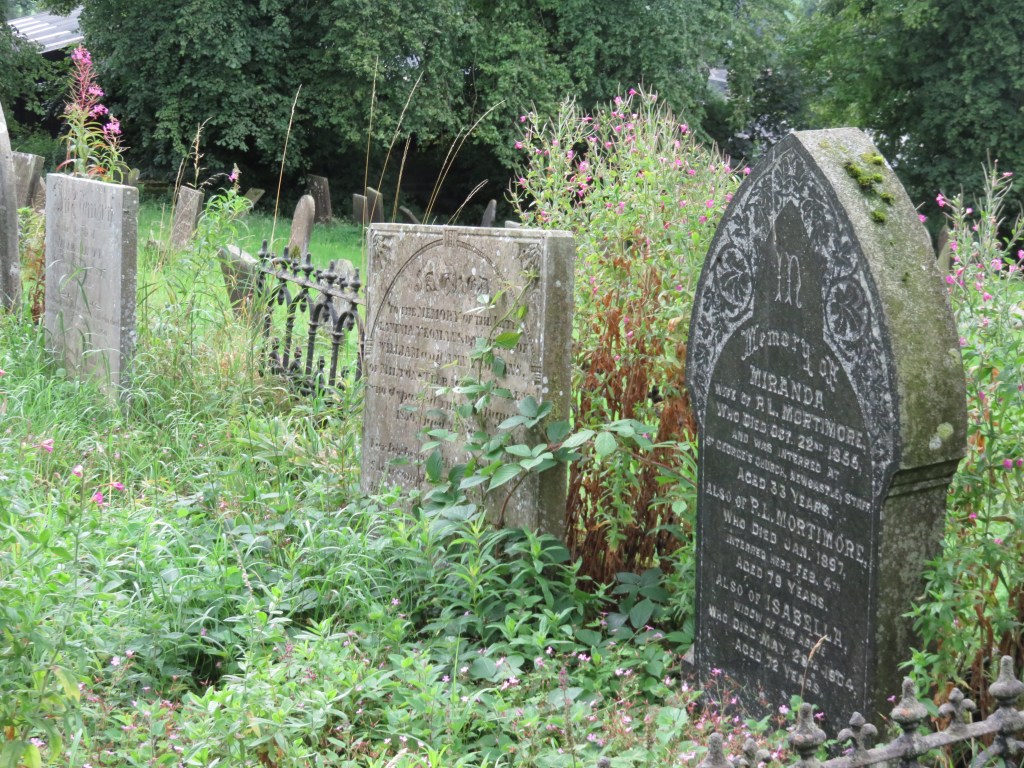
I have spoken about my summer trip to Derbyshire a lot in my last few posts (it obviously had an impact), and I am reminded of this again. Chelmorton (the village I was staying in), of course had its own church surrounded by graves. I happened to notice the ornate nature of many of the headstones- indeed they were certainly more ornate than many I have seen on my trips around Somerset graveyards. But what does this mean? Does it mean that those being buried in Chelmorton were wealthier? Or is it an example of a tradition of using more ornate headstones in that particular area? Some more research would be needed to understand the differences here and why they may have come about. It does indicate though that yet another aspect beyond collecting family information is that of wider societal views and trends.
A meeting of more than archaeology and genealogy
So, whereas Alice Roberts is largely interested in pre-history, the techniques of looking at more than just the ‘bones’ as it were, is still applicable to genealogy and family history. Perhaps there are sources that historians and archaeologists use that genealogists could also utilise (and vice versa)? Future research would be needed to fully explore this, but one example is the Portable Antiquities Scheme that I mentioned earlier. Not only does it contain seals (of various dates and materials), but coins, jewellery, vessels of different purposes and much more. This can all help us to understand the world of our ancestors. As Alice Roberts uses bones and grave goods, we can use documents, memorials, objects and history to help in our understanding.
We may be purveyors of family trees, but really we are also historians and social ones to some extent too. Without the ‘why’ surrounding the names and the dates, there is not as much meaning. What many people enjoy are the stories, and without investigating the wider background, the stories of our ancestors are left a little bare. There is so much more that cross-disciplinary work can tell us, whether that is local/social history, archaeology or DNA research.
The inspiration for this post came about from several different threads that I have had in my mind recently. Firstly, my attendance at the Register of Qualified Genealogists Conference (which took place on 25 September) and the Society of Antiquaries Conference on 09 October. And secondly, my intention to apply for full membership of AGRA (the Association of Genealogists and Researchers in Archives). Other thoughts have been simmering in the background, which have prompted me to think about the subject of Continuing Professional Development (or CPD).
Who needs to undertake CPD?
CPD is of course not unique to genealogy and family history- you find the idea in every job and occupation. The intention is to encourage employees to continue to be the best they can be in their job, by keeping up with current developments or by continuing to learn about best practices in their job, for example. This is something that employers are encouraged to offer, so what about those of us who are self employed, or are only researching as a hobby? Should we be concerned about CPD too?
The short answer is of course, yes, but this leads onto my point of CPD being a chore or a challenge. Those of us who do not have CPD in-built into our lives via an employer, have to work a little harder to fulfil the needs of CPD. This is where CPD can become a chore. Speaking from my own experience, thinking of CPD as a separate “subject” which has to be approached clinically (be planned, written down and evaluated), can frankly turn it into a chore.
My own experience of CPD
Perhaps it is just the way my brain works. My first career was in music, and so I was used to thinking creatively for a large proportion of the time. That is not to say that logic, planning and evaluation did not play a part at all, but everyday I had to learn how to elicit emotional responses from my work. Therefore for me, the idea of analysing the learning that I do fills me with dread, as it feels as if it takes away the feeling of having learned it in the first place. Perhaps I operate on a more instinctive level in some aspects of my life.
For me, I have had to learn to think differently in the way I approach CPD (which is still ongoing by the way!). I still find it much easier for there to be an organic initial approach. By way of explanation, I mean that I respond much better to things that I can relate to and have not had to attend, just for CPD purposes. I am sure I am not alone there, but of course life does not always work that way and a certain amount of compromise is needed!
There is no doubt that I enjoy learning. I always have, so there is no issue in undertaking CPD itself. I just prefer it when things fit together without forcing the issue. That seems like a vague statement, and indeed it is difficult to put into words exactly what I mean. An example would be my recent trip to Derbyshire (you can find the post I wrote about that here). There were so many interesting places to visit, especially from a historical point of view. I did not plan to visit specific places because they filled a certain CPD need, but because they seemed interesting and I wanted to learn about them. They just so happened to fulfil a CPD related purpose as well. After visiting Hardwick Hall, I bought Bess of Hardwick’s biography (written by Mary S. Lovell), which turned out to be much more informative and fascinating than I could have predicted (I sometimes find biographies difficult to get through, depending on the writing style). Unwittingly, I now have a much more informed understanding of not only Bess of Hardwick’s life, but also of the intricacies of Tudor court relations, the role of Lord of the Manor in the period and other small aspects of everyday life that sometimes get overlooked. As a text, it was very readable and also helped to put Bess into the wider context of her time.
Photo by Austin Distel on Unsplash.
So, with my interest in Medieval and Early Modern genealogy, you could say that I undertook a good bit of CPD there. However, it was completely unplanned and that sort of CPD makes more of an impression for me.
CPD and Society Membership
But, as I mentioned earlier, life does not always work that way. As a consequence, I have to temper my instinctive way of thinking with a little bit of planning and organisation, in order to get the best from my CPD experiences. My attendance of the RQG and Society of Antiquaries conferences are a case in point. They did not come about by happy accident, but by concerted thinking about what they may have to offer in terms of CPD. As a result, I also found them full of interest and useful from a CPD standpoint.
Another point to consider, is that any professional organisations that a person joins may have their own ideas concerning CPD. Both the RQG and AGRA stipulate the provision of ongoing CPD for members. It is something that you must do to be a part of their organisation. This is again where the ‘chore’ aspect of CPD rears its head. In order to prove that you have undertaken CPD, these organisations ask that it is all recorded. Now, that is actually a very logical approach. Even if membership of professional organisations is not a goal, keeping track of the CPD you have done means that you can remind yourself of what you have already achieved. Reflecting on learning undertaken can help us grow and identify areas of improvement, or areas in which we would like to learn more.
On the other hand, this requires further time. Not only do you have to undertake the CPD activity, but you have to write it down and reflect later. This is not something that comes naturally to me, but as I have said, I have had to adjust my thinking a little. In an already busy life, the additional step of writing down and reflecting can get put to the bottom of the pile, even if the CPD activity is undertaken. Building time into the day/week/month to update a CPD log can be a helpful way to go and eventually it should become second nature. It is a) a necessary step in order to belong to certain professional organisations and b) beneficial to our CPD journey in the long run.
Just keep learning!
At the end of the day, interest and curiosity in our subjects is the key. CPD needn’t be a chore but a wonderful challenge. A challenge to ourselves to keep learning and finding out more about a subject that we are passionate about already. And the ‘chore’ portion can be mitigated with a little organisation and a realisation that both our own learning and the areas we work in deserve that little extra effort.
There are bound to be those whose experience with CPD has been different to my own. My own approach is neither right nor wrong, or the only way of approaching the issue. I only hope that if you have struggled a little with the idea of CPD, that you can still be inspired by your subject and that CPD becomes more challenge than chore!
Sometimes the inspiration for a post comes from an unexpected place. I spent some time in Derbyshire this year, and whilst I wasn’t intending to work, the history of the place inspired me. It turned out to be a bit of a busman’s holiday I suppose!
Chelmorton and Buxton
Perhaps I should not have been surprised, as there are a lot of historical locations and attractions around Derbyshire. Right on the doorstep of the place I was staying was the immensely historical Church Inn of Chelmorton. As well as being situated in the highest village in Derbyshire, the history of the pub stretches back to at least the 17th century. Across the way from the Church Inn, is the village Church itself. St. John’s has a large set of graveyard memorials, many of which are much older, and more ornate than any I am used to seeing around Somerset.
On a visit to Derbyshire, I of course had to visit Buxton. I will admit that I spent most of my time at the bookshop, Scrivener’s, and I even managed to pick up some good bargains on genealogical/historical books. One of my favourite finds was Brass Rubbing by Malcolm Norris. Although published in 1977, I hope that the images of female brasses will help me in my quest in reproducing a woman’s outfit from the 1460s/1470s. This is around the time when one of my ancestors (Joan Sydenham) died. You can find out more about this quest (and my reasons for pursuing it) in one of my previous posts here.
Chatsworth and the Hunting Tapestries
The big excursions for me were visits to Chatsworth House (how could I not?), Hardwick Hall and Eyam. I have been to all three of these places on a previous visit, but it was many years ago now and it was great to be able to look at them again with fresh eyes.
Chatsworth obviously has bags of history in the form of the Dukes of Devonshire and their ancestors, but this time the most interesting part for me was their most recent exhibition. The ‘Life Stories’ Exhibition runs until the beginning of October this year and explores certain individuals through a specific painting or object. Henry VIII’s rosary was particularly fascinating and was quite frankly, far too large to be carried around on a regular basis in my opinion! Bess of Hardwick’s pearl necklace was another fascinating object. Although a replica of an original, it was apparently made from 1000 pearls. Given the nature of pearls and the way they are made, this was quite simply a statement of Bess’ accumulated wealth and status. The icing on the cake for me this time though, were the Devonshire Hunting Tapestries. Originally belonging to the Cavendish family, they are now part of the V&A Museum collection in London. The Museum has loaned them back to Chatsworth for this year, and they are quite a sight to behold!
Now, I am not the biggest fan of hunting scenes on the whole, but I am sure you can guess where this is going. The tapestries have some wonderful examples of period clothing! They are a little bit earlier than my target period, but are terribly interesting and useful nevertheless. Who knows, perhaps I may expand my efforts to other Medieval periods in the future?
Hardwick Hall and Bess of Hardwick
Chatsworth was not the only place where I encountered Bess of Hardwick. As I have already mentioned, one of my other excursions was to Hardwick Hall. For those in the know, I will not have to tell you that Bess was the wife of Sir William Cavendish and the ancestor of the Dukes of Devonshire. Bess also had a hand in building both Chatsworth and Hardwick Hall. The National Trust property stands right next door to the old Hardwick hall, which is looked after by English Heritage.
But there is much more to Bess’ story than merely being the sire of an illustrious family. Bess experienced widowhood four times in her life; she outlived all four of her husbands and used her widowhood to great advantage. Climbing up the social ladder, her fourth (and final) husband was the 6th Earl of Shrewsbury, George Talbot. On the other hand, her first husband (Robert Barlow) had been of a significantly lower status. Bess’ third husband, Sir William St Loe, is on my to-do list to look into- his surname is curiously similar to that of some locations and places in Somerset.
Increasing my reading list further is the biography of Bess’ life: Bess of Hardwick, First Lady of Chatsworth, by Mary S. Lovell. In light of my Medieval interests and in particular those relating to Medieval women, Bess’ story is a fascinating one for me. She may not have been a Somerset woman, but she was a powerful and important one nonetheless.
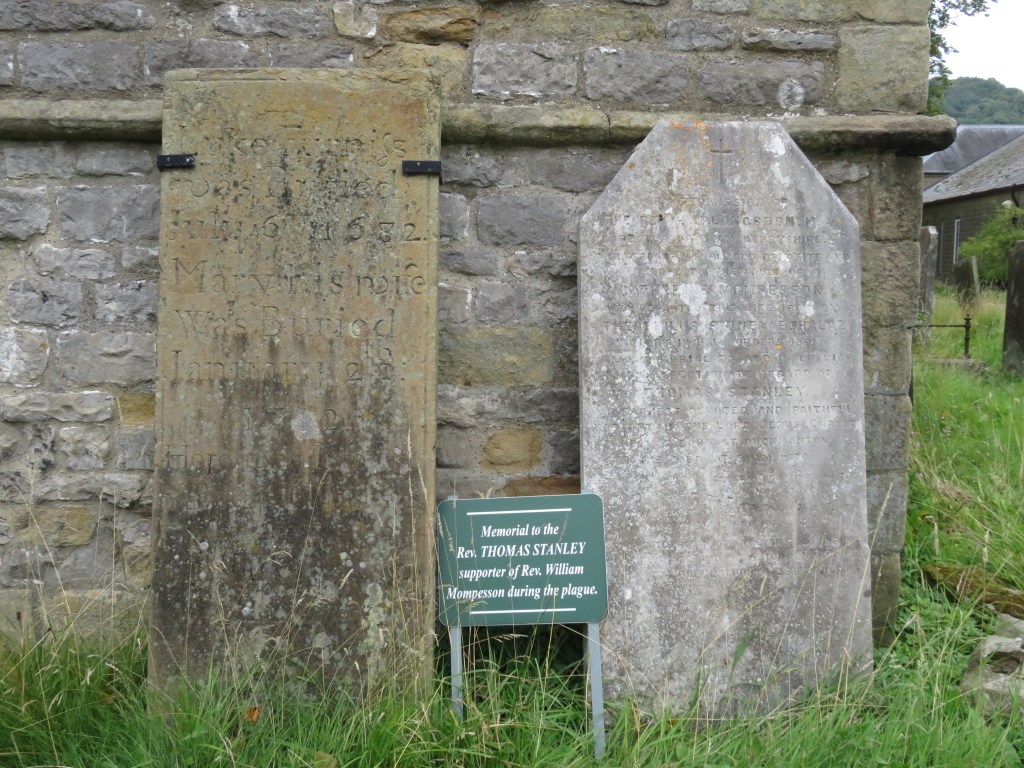
My final outing in Derbyshire took me to the village of Eyam (not pronounced ‘I-am’ as my Somerset brain initially thought!). Famous for being the ‘Plague Village,’ the museum contains a fascinating exhibition concerning the plague in Eyam. It then makes sense walking around the village and seeing the places mentioned in the exhibition.
Since my first visit, the curators of the museum have significantly re-vamped and improved the exhibition. Consideration is given to the sort of disease that might actually have run rampant in the village (possibly not Bubonic Plague), how it might have gotten there, as well as the human cost. What particularly impressed me was the amount of research that had been done in local surviving records from the time, both to give a picture of the families that had succumbed to the plague, but also to try to get to the bottom of the facts of the matter. I remember reading in the exhibition that the estimate made at the time of the death toll and the number of survivors might be somewhat conservative in both cases- other documents and pieces of evidence from the time suggested different figures.
Most people will remember that the Plague swept through England in the 1300s, but will have forgotten that there were various outbreaks since then. The outbreak in Eyam took place in 1665-1666. The exhibition is perhaps particularly poignant at the moment with the ongoing COVID-19 crisis, as the villagers of Eyam made the decision (back in the mid-1600s) to isolate themselves from the outside world, in order to stop the spread of the disease. In an era when the exact cause of disease was not fully understood, the villagers were ahead of their time.
What cannot be forgotten though, were the devastatingly sad stories of people being the only survivor in their families, parallels which can certainly be drawn today. As a genealogist though, seeing that the time and effort had been made to record the stories of these families (by using good research) was great to experience. It is a visit I would certainly recommend to anyone in the Derbyshire area.
So that is about it for my history inspired holiday to Derbyshire. If you are ever in that area (if you are not lucky enough to live there already), then I hope you enjoy it as much as I have!
My One Name Study began in a similar way to many others: I came across an ancestor with a particularly interesting surname. After looking further into that person and her ancestors, I also found that I was hitting potential brick walls if I wanted to get back any further. After further research, there seemed to be a whole raft of people with the same surname in certain areas around where my ancestor lived. This led to the question: could they be related in any way? Now, I cannot quite remember the point which I discovered One Name Studies and the process of beginning one, but begin I did.
The beginning of the Rowsell ONS
This all started a few years ago now, without much direction and with less experience than I have now. I am sure that I will look back in a few years’ time and think much the same thing! In any case, I started gathering UK Census information and I also started looking at Parish Registers, wills and a few other bits and pieces. As I said, not much logic and direction. Then, when I visited Family History Live in 2019 I discovered the Guild of One Name Studies (brilliant acronym of GOONS!). After joining the society, their “Seven Pillars of Wisdom” text helped me to structure my research more and I have made better (and more logical) in-roads into my surname search. In fact this was the subject of my very first blog post, two years ago now! My progress is perhaps not as rapid as some, as I have both my genealogy business and my work tutoring with the University of Strathclyde filling my time. But, I try to do what I can when I can, as I am determined to get to the bottom of my Rowsell ancestors!
Mary Ann Rousell (1832-1929)
The beginning of the story starts with the discovery of Mary Ann Rousell on my maternal line. She was the mother of my great-great grandmother (Sarah Hawker), who came from Odcombe, Somerset. Sarah was the ancestor who had an illegitimate child with her sister’s husband. You can read all about that in my previous blog post, A Family Mystery Finally Solved.
Back to Mary Ann then. Having worked backwards through her life, I eventually found out that Mary Ann was born Mary Ann Rousell, in Merriott, Somerset. Her baptism took place in Merriott on 25 November 1832, to Robert and Ruth Rousell. Robert was a weaver.[1] She lived with her mother Ruth in 1841 (in Merriott),[2] and possibly lodged with a family in Crewkerne in 1851,[3] the year before her marriage. Mary Ann’s marriage took place in the Beaminster district of Dorset, to Simeon Hawker in 1852. [4] Luckily for me, there was only one marriage ever recorded in the Marriage Indexes for a Simeon Hawker, as the couple were not married in the parish church (I just haven’t gotten around to buying the certificate yet)! The couple then made their lives in Odcombe, Somerset, Mary Ann outliving her husband Simeon and likely passing away in 1929.[5]
The mystery for me came with Mary Ann’s father Robert, and his father. I managed to find a baptism that was likely Robert in Merriott in 1791, born to Robert and Hannah Rowsell[6] but no matching baptisms for Robert senior. It is possible he may have come from one of the surrounding villages. My current hypothesis is Seavington St. Mary, but this is really why I began my Rowsell One Name Study. I dearly wish to discover the origins of Mary Ann’s family. As the surname is quite abundant in South Somerset, I felt that a One Name Study would both help me to find Mary Ann’s origins and any connections between the families that share the name. Another important point is the difference between ROUSELL and ROWSELL. You might have noticed that Mary Ann was ROUSELL, whilst her father Robert was ROWSELL. Any interchangeability between these variations is another aspect I wish to discover. Did the families with different variants specifically use that variant and no other, or were they liable to change over the years and different circumstances? Illiteracy and local pronunciation may have had an impact on this, but from the beginnings of my research, it seemed that the different variations were more common in certain areas.
At this point, I must not forget the third variation of ROWSWELL. Of course, there may be other spellings such as ROUSEWELL, and then there is the issue of ROSWELL, ROSEWELL and any possible link to the surname RUSSELL. These issues will be tackled at a later date, and my current efforts are concentrated on the main three variations: ROWSELL, ROUSELL and ROWSWELL.
Somerset Births, Marriages and Deaths
Making my One Name Study official certainly helped me to focus my efforts, and so I have been gathering data from the most obvious place to start: the England and Wales Births, Marriages and Deaths indexes. I have begun with Somerset and then hope to expand those to the rest of the UK at a later date. I am part way through compiling spreadsheets to record the Marriages and Deaths indexes data, but I have now completed the spreadsheet for the Somerset Births index. Of course, there will be further data to collect as further years become available. For now though, I have collected data for all Rowsell births (with the two variants) for Somerset between 1837-2006. I have used various different databases at various points of the research to enable me to cross check entries, and it also became clear that I would need to set some rules regarding the areas considered to be ‘in Somerset.’ Due to the changing boundaries over the years (significant changes happening in 1936 and 1974), I have had to think about which places were within the county at which time and how that will affect my data collection.
As a result though, I am excited to be at the point where I could perform some basic analysis on the numbers of Somerset Rowsell births. At a basic level, I can now tell how many births there were, which district they were located in, and the split between the districts. At the moment, it seems that ROWSELL is by far the most common spelling, followed by ROWSWELL and with ROUSELL the least common. Time will tell what that means for Mary Ann’s spelling of Rousell versus Rowsell, as I also hope to create family trees for the different families- I may be able to discover any links between families and the different spellings used.
Some basic analysis
Looking at the number of births by decade, there does seem to be an increase throughout the Victorian period and a general decline throughout the 1900s. This may tally with the Victorian population explosion and later decline, but what interests me most, is how the births are spread between the different registration districts. Currently, my initial thoughts that the surname is very much a South Somerset name could be correct. The top four districts with between 150 and about 300 births each (looking at the first period of 1837-1936) are: Chard, Taunton, Yeovil and Langport. Each of the other 15 districts of the period all had under 100 births. The chart you can see is a rough layout of these figures (and gave me a chance to play around with pretty pictures!). I am really looking forward to digging deeper into this and then to comparing these figures to what was going on nationally.
[1] Baptisms (PR) England. Merriott, Somerset. 25 November 1832. ROUSELL, Mary Ann. Collection: Somerset, England, Church of England Baptisms, 1813-1914. www.ancestry.co.uk : accessed 25 July 2021.
[2] Census records. England. Merriott, Somerset. 06 June 1841. ROUSELL, Mary Ann. PN: HO107/940. FL 41. BN 5. ED 19. p. 8. http://www.ancestry.co.uk : accessed 25 July 2021.
[3] Census records. England. Crewkerne, Somerset. 30 March 1851. ROUSELL, Mary. PN: HO107/1928. FL 376. SN 105. ED 8a. p. 29. http://www.ancestry.co.uk : accessed 25 July 2021.
[5] Deaths indexes (CR) England. RD: Yeovil [Somerset]. 4th Q., 1929. HAWKER, Mary A. Vol. 5c. p. 402. www.freebmd.org : accessed 25 July 2021.
[6] Baptisms (PR) England. Merriott, Somerset. 05 January 1791. ROWSELL, Robert. Collection: Somerset, England, Church of England Baptisms, Marriages, and Burials, 1531-1812. www.ancestry.co.uk : accessed 25 July 2021.
Just a few weeks ago, I attended the University of Kent Medieval & Early Modern Studies (MEMS) Festival. By now, you probably know that Medieval genealogy is a big interest of mine and so it is not surprising that the MEMS Festival would be appealing. The Festival itself was a large affair, taking place over three days. There were four sessions a day (each split into two different subject areas), which included two to three presentations of papers. The sheer volume of papers and speakers was phenomenal! Not having been to a MEMS Festival before, I don’t know how it usually works (this year it of course took place online), but I wondered if perhaps it was trying to fit a little too much in? The talks I attended were very brief and there was not the time for the speakers to go into any great detail. In any case, it was quite a feat of organisation and my hat goes off to the organisers at the University of Kent for pulling it all off, despite the usual technical hitches.
Inspiration from MEMS Fest
The talk I was most interested in was in the section ‘Needlework of History.’ That particular section included talks on the topic of historical clothing and needlework used in devotional books. Cecilia White’s (from the University of Kent), ‘Recreating Historical Clothing’ was of particular interest, as I have recently been thinking more about the clothing our ancestors would have worn. In a bid to further understand my Medieval ancestors and those I research, I have begun a new side project. Eventually, I hope to make my own Medieval outfit of the sort worn by one of my own ancestors, Joan Sydenham (neé Stourton). I did write a previous post (or two) about the Stourton family and my own connection to them, which you can find here and here. I am still seeking further confirmation (research has been almost non-existent recently due to COVID restrictions in archives), but what I have so far looks promising!
Whatever the outcome for my own Medieval connection, going through the process of learning about (and subsequently trying to recreate) Medieval clothing will better help me to understand what life was really like for my Medieval ancestors. The more well to do women would likely not have made their clothes themselves, but the act of choosing cloth, learning about sewing methods and taking the time to put that into practise to make a garment, will add to the background knowledge that I have when I research. Understanding the period will help to make me a better researcher.
Why bother making historical garments?
Gaining further knowledge of the period is exactly the sort of thing that Cecilia White’s talk suggested. Making a historical garment can tell us information about those who wore it, beyond the genealogical. For instance, if a garment uses a lot of material, then the wearer would need to have been wealthy enough to afford it. Likewise, something I had not considered was the potentially unwieldy nature of some garments. If people were wearing these sorts of garments on a daily basis, then they would have been wealthy enough to not need to undertake many activities in such a restrictive garment. It is a case of practicalities- those who needed to work, needed garments that allowed them more freedom of movement. Those who did not need to work (or perform the same sort of activities), could wear garments that were more of a fashion statement. This then becomes a statement of status too.
Where can I find information on the topic?
As well has having attended Cecilia White’s talk, I have found many channels on YouTube that also cover the same subject. Cecilia herself is an ‘experimental archaeologist,’ someone who tries to recreate items from history using any physical and documentary evidence gathered. Whilst the YouTubers do not label themselves so formally, to my mind, they are practising a form of experimental archaeology, in searching for patterns of the time, looking at the materials that would have been used, the type of person that is being portrayed, and garment construction techniques of various periods. Those channels that I have found so far concentrate on a range of periods and not just Medieval dress, but they are fascinating to watch! The below is a list of those I have looked at so far and have found to be interesting and useful in content:
And for something more general about sewing: Evelyn Wood
(it goes without saying that any opinions etc. on these channels are their own- I am not affiliated with them in any way)
How will I go about this?
So for my own project, I plan to try to recreate the sort of outfit that may have been worn by my ancestor, Joan Sydenham. Joan died on 21 April 1472[1] and the family were based at Brympton, near Yeovil, Somerset. There are various stages to this project, which I plan as follows:
Research- looking for sources that tell me what Joan might have worn. I am particularly interested in looking for Wills that might include clothing, and monumental inscriptions and other images which might show what a woman of the time was wearing. The second portion of the research will be to look at texts which have been written by other authors who have researched sewing and dress-making techniques of the time. I already have my YouTube channels and The Medieval Tailor’s Assistant by Sarah Thursfield, but there are others that I wish to look at.
Planning- Thinking about the time period, Joan’s social rank, her marital status (a widow in this case). These will all have a bearing on the layers needed to produce the full garment, which can then be drafted using methods of the time.
Production- The final stage will be making the garments- yes garments plural! Not only will I need to make undergarments, outer garments and headwear, but I am also planning to test each one out first before I cut up proper fabric! I am more at the beginner end of sewing, so this is an important step for me. Learning to fit will also be a bit of a learning curve, so test pieces will be a must!
There is a lot to think about in a project such as this and as I have more experience in knitting than in sewing, it will take some time. I am not giving myself a particular time limit (due to work pressures and my recent shoulder and wrist issues), but I will keep you updated as I go along. There are many videos of this sort of thing on YouTube now, so I will instead keep blogging and writing about it instead. The below photograph is a sneek peek of my first attempt at what The Medieval Tailor’s Assistant calls a fillet. Something a bit like a hairband made of material, that probably sits under most headdresses.
[1] Inquisitions Post Mortem. England. Crewkerne, Somerset. 31 October 1472. SYDENHAM, Joan. Collection: Chancery: Inquisitions Post Mortem, Series I, Edward IV. Reference: C 140/42/45. The National Archives, Kew, London, England.
Welcome to my latest post! Previously, I explored the life of one Gouly de Chaville whom I found in a chance survey of the Preston Plucknett tithe records from 1848. Gouly de Chaville turned out to have been a Frenchman originally named Paul Benoit Joseph Gouly; the ‘de Chaville’ seems to have been added after his migration to England. Not only did Paul lead an interesting life of language teaching and a somewhat nomadic lifestyle, but his choice of surname led to a new surname being formed and a new family name. Paul was not generally known simply by his birth surname of Gouly, but by ‘Gouly de Chaville.’ Possibly a moniker to mark him out from other Frenchmen, but also perhaps to show pride in his country and birthplace. This change of surname had farther reaching consequences for the surnames of his children and wider family.
The story of five children
As I mentioned in my previous post, Paul had at least five children with his first wife Harriett (or Henrietta) Maria Sanders. Harriett then sadly passed away in February of 1864,[1] the informant not her husband but likely a relative of Digory Gordge. Harriett had been living with Digory and his family at the time of the 1861 Census, in Charmouth, Dorset,[2] and was also buried there on the 12th of February, aged 60.[3] Paul did remarry to Annie Mason on 20 April 1865, in Christchurch, Hampshire.[4] The couple had no children though, and Annie outlived Paul by twenty one years; she died back in Hampshire in 1911,[5] although the couple had continued their travels having been located in Aberystwyth at the time of the 1881 Census[6] and Worthing, Sussex at the time of Paul’s death in 1890.[7]
So what of Paul’s children with first wife Harriett? From census records found, the children of that union were Emma (or Emma Maria), Edward James, Henry Hugh, Mary Frances and Pauline Maria. They were all born between 1825 and 1837, mostly in Hillingdon, Middlesex (some records say Uxbridge), although Pauline was the only child to have been born in Reading, Berkshire. As I have previously explained, I have so far been unable to undertake a full search for their baptisms for COVID-19 reasons. You may also ask why I am writing about Paul’s children at all? It was Paul after all that unwittingly changed his surname from his birth name of ‘Gouly’ to ‘Gouly de Chaville.’ Surely his children would all carry that name? In actual fact, his children carried a mixture of surnames. It would seem that they could not decide upon one either!
Emma Maria was the eldest and born in about 1825.[8][9] Her life is perhaps the least interesting from a researcher’s perspective, as she became a teacher and died unmarried in Burwash, Sussex, on the 23 July 1898.[10] She was buried in Burwash two days later.[11] Emma had taken after her father in some respects though, as she has been located in many different residences throughout her life. These were in various guises of teacher, governess and my personal favourite ‘daily instructress.’ After 1851 (where Emma can be found with her mother and sister Mary in Charmouth), Emma never again is living with family members. Of course, this does not mean that there was never any contact with her family; who can tell what went on between the census years without further research? But, it does make me wonder how close a family they were. In any case, the most interesting aspect of Emma’s life (to this research at least), is the surname that is recorded for her throughout her life.
The 1861 Census, whilst in Taunton, Somerset, records her as Emma CHAVILLE.[12] This is also the case for the 1891 Census, when she is in Etchingham, Sussex.[13] The 1881 Census for Hythe, Kent[14] and her death and burial records in Burwash however, all record her as Emma DE CHAVILLE. There is a further difference in the 1871 Census for Crediton, Devon, where she is Emma M. GOULY DE CHEVILLE.[15] Whether Emma meant it or not, she is rarely recorded as using the name Gouly at all, and essentially perpetuates a ‘new’ surname of CHAVILLE or DE CHAVILLE.
Mary Frances and Pauline Maria De Chaville
Both of Emma’s younger sisters Mary Frances and Pauline Maria have sadder stories to tell. Pauline Maria (the youngest, born in about 1837[16][17]), died on 10 February 1856, in Taunton, Somerset. That would suggest that the family could still have been around that area at the time, as her sister Emma was still in Taunton in 1861. Being the youngest, Pauline was still in school in 1851 and attended Knapp House in Milborne Port, under the tutelage of school Mistress Anne Kelloway.[18] On that record, she was Pauline DU CHAVILLE and upon her death certificate of 1856, she was Pauline Maria Gouly D’CHAVILLE. Pauline was buried in Taunton five days after her death at St. Mary’s Church, Taunton and had been a school teacher living at Park Street in Wilton.[19] Regrettably, she was only 19 when she died.
Mary Frances (born in about 1831[20]), also had a sad life. Most of the census records do not even record her name, only her initials. This was due to her residency at the Fisherton Anger Lunatic Asylum near Salisbury, Dorset. In the future, I hope to discover more about her time there, so that her story can be told along with that of her siblings. Mary Frances spent most of her life in that Asylum, from at least 1861[21] until her death in December of 1901.[22] She is generally identifiable by an occupation of ‘daughter of a tutor’ and similar. Although when she is named in the Census of 1901[23] and in her death certificate later that year, she is Mary Frances Gouly DE CHAVILLE. So, yet again, this new surname of ‘De Chaville’ is used, rather than her father’s initial family name of ‘Gouly.’
Henry Hugh Gouly de Chaville
This brings me to Paul Gouly de Chaville’s two sons, Edward James and Henry Hugh. Henry Hugh (born in about 1829[24][25]), was following in his father’s footsteps and working as a professor of languages (French and German) in 1851.[26] This was in Chard, Somerset, in the household of George Dunn. But a mere ten years later, he could be found in Downton, Wiltshire, living with the local vicar, having become a clerk in holy orders.[27] It is currently unclear what prompted this momentous shift in occupation! His surnames were a mixture of those of his sisters Emma and Mary Frances; on these records he was known as either Henry GOULY DE CHAVILLE or Henry H G DE CHAVILLE. Although Henry Hugh also died relatively young (like his sister Pauline), he did marry and was able to pass on his surname. So far, five children have been found for Henry and his wife Lucy Elizabeth (neé Fairthorne). The couple married on 12 February 1862, in Longcot, Berkshire,[28] eight years before Henry Hugh’s death at the age of 41.[29] The family had moved down to Devon, before Henry’s wife Lucy moved back to Wiltshire to spend her days at the Duchess of Somerset’s Almshouses in Froxfield.[30] The Almshouses were set up specifically to house the widows of clergymen residing within 160 miles of London.[31] Lucy then ended her life as Lucy Elizabeth GOULY DE CHAVILLE on 29 August 1913,[32] having never remarried. Further research is needed for Henry and Lucy’s children, but so far, they seem to have carried either the surname of GOULY DE CHAVILLE, or simply DE CHAVILLE.
Edward James Gouly
The last of Paul Gouly de Chaville’s children is Edward James, born in about 1827.[33][34] Whilst not the oldest, he was the oldest boy and perhaps this is why he subsequently used solely the surname GOULY throughout his life. Further research into any French naming practices that might govern this choice would need to be performed, but there is no variation with GOULY DE CHAVILLE or even DE CHAVILLE like his siblings. Subsequently, he was by far the easiest to locate and also the family member who did the least travelling. Edward’s marriage to Elizabeth Frances Dearsly took place on 24 August 1844, at Holy Trinity Church in Islington, Middlesex. Edward was still a minor at about 17, but had already found employment as a clerk for the Bank of England.[35] This was an occupation he carried on until sometime before 1895, when he was recorded as being retired on his second wife’s death certificate.[36] His first wife Elizabeth, died in 1853[37] and Edward then remarried twenty nine years later on 01 June 1882. This second marriage was to Julia Marianne Hawkey, who was residing in Bournemouth at the time, which is also where the marriage took place.[38] Coincidentally, this is not far from where his father Paul married his second wife in 1865.
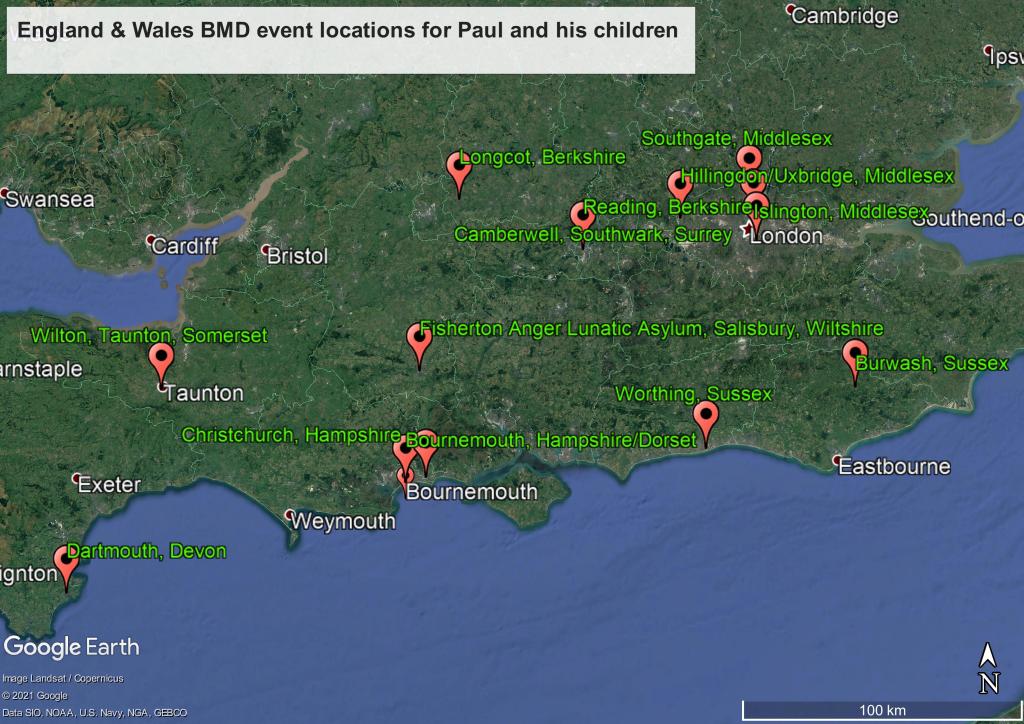
A map of the locations of BMD events for Paul and his children. Map copyright of Google.
As Edward had steady employment, so he had a more steady residence than his father and most of his siblings. Islington was where Edward and his family lived until 1871 at least, living first at 11 Eden Grove[39] and then at number 5, St. John’s Park, St. Mary’s, Islington.[40][41] Just before his second marriage, Edward moved to the St. Pancras area of London and lived at number 25 (or St. John’s Lodge), Dartmouth Park Avenue[42][43] until sometime between 1901[44] and 1911.[45] By 1911, Edward had moved again to Bounds Green in New Southgate, Middlesex, outliving even his second wife Julia, who died in 1895.[46] Edward died himself at 1 York Road, Southgate on 04 December 1916, at the grand old age of 89.[47] He left just over £2,000 in his estate,[48] and had also been one of the executors of his stepmother Annie’s estate upon her death five years earlier.[49] It must have been a slightly strange family dynamic when Edward was about five years older than his stepmother Annie!
Two surnames for the same family
Like Henry Hugh, Edward James passed his surname on to his children (also five, by his first wife Elizabeth). But this time, the surname passed on was GOULY, with no exceptions. Their father Paul’s family surname could live on in its original form, but only through one of his children! Only Henry Hugh had any other descendants and he passed on the variations that were created when Paul decided to add ‘de Chaville’ to his own name. What this has created is two branches of the same family with completely different surnames! This makes it more likely that anyone researching one of these branches may not make the connection with the other, at least to begin with.
There is much left to discover in Paul’s family and there are even hints that the descendants of Edward James and Henry Hugh may have Australian and South African links. What I have found so far has only just scratched the surface, so I am looking forward to adding to their stories in the future. What I have outlined in this series of posts though, is that through one man’s decision, a whole new surname or set of surname variants was created. They in turn were cemented by constant use and appearance in official records, and it all started with ‘Gouly de Chaville’ being recorded in the 1848 Preston Plucknett tithe records. The smallest or most innocuous entry in a record, really can spark something immense!
[2] Census records. England. Charmouth, Dorset. 07 April 1861. DE CHAVILLE, Harriet M G. PN: RG9/1370. FL 66. SN 39. ED 1. p. 6. http://www.ancestry.co.uk : accessed 13 December 2020.
[3] Burials (PR) England. Charmouth, Dorset. 12 February 1864. GOULY DE CHAVILLE, Henrietta Maria. Collection: Dorset, England, Church of England Deaths and Burials, 1813-2010. http://www.ancestry.co.uk : accessed 10 December 2020.
[6] Census records. Wales. Aberystwyth, Cardiganshire. 03 April 1881. CHAVILLE, Paul Benoet. PN: RG11/5445. FL 44. SN 362. ED 1b. p. 6. http://www.ancestry.co.uk : accessed 26 November 2020.
[11] Burials (PR) England. Burwash, Sussex. 25 July 1898. DE CHAVILLE, Emma. [Transcription only.] Collection: Sussex Burials. http://www.findmypast.co.uk : accessed 06 January 2021.
[12] Census records. England. St. Mary Magdalen, Taunton, Somerset. 07 April 1861. CHAVILLE, Emma (head). PN: RG9/1617. FL 68. SN 127. ED 9. p. 17. http://www.ancestry.co.uk : accessed 06 January 2021.
[13] Census records. England. Etchingham, Sussex. 05 April 1891. CHAVILLE, Emma. PN: RG12/779. FL 62. SN 56. ED 6. p. 9. http://www.ancestry.co.uk : accessed 06 January 2021.
[14] Census records. England. Hythe, Kent. 03 April 1881. CHAVILLE, Emma M G de. PN: RG11/1014. FL 78. SN 275. ED 9. p. 52. http://www.ancestry.co.uk : accessed 06 January 2021.
[15] Census records. England. Crediton, Devon. 02 April 1871. GOULY DE CHEVILLE, Emma M. PN: RG10/2161. FL 44. SN 33. ED 3. p. 6. http://www.ancestry.co.uk : accessed 06 January 2021.
[17] Deaths (CR) England. Wilton, Taunton, Somerset. 10 February 1856. D’CHAVILLE, Pauline Maria Gouly. Entry no. 126.
[18] Census records. England. Milborne Port, Somerset. 30 March 1851. CHAVILLE, Pauline du. PN: HO107/1931. FL 297. SN 81. ED 3c. p. 20. http://www.ancestry.co.uk : accessed 08 January 2021.
[19] Burials (PR) England. St. Mary, Taunton, Somerset. 15 February 1856. DE CHAVILLE, Pauline Maria Gouly. Collection: Somerset, England, Church of England Burials, 1813-1914. http://www.ancestry.co.uk : accessed 10 December 2020.
[21] Census records. England. Fisherton Anger, [Salisbury], Wiltshire. 07 April 1861. C, M F G D’ [CHAVILLE, Mary Frances Gouly De]. PN: RG9/1315. FL 150. SN 1. ED Fisherton House Lunatic Asylum. p. 18. http://www.ancestry.co.uk : accessed 14 January 2021.
[22] Deaths (CR) England. Fisherton Anger, Wiltshire. 08 December 1901. DE CHAVILLE, Mary Frances Gouly. Entry no. 437.
[23] Census records. England. Fisherton Anger, [Salisbury], Wiltshire. 31 March 1901. DE CHAVILLE, Mary Frances G. PN: RG13/1951. FL 142. SN 1. ED Fisherton House. p. 6. http://www.ancestry.co.uk : accessed 08 January 2021.
[25] Deaths (CR) England. Dartmouth, Devon. 07 December 1870. DE CHAVILLE, Henry Hugh Gouly. Entry no. 374.
[26] Census records. England. Chard, Somerset. 30 March 1851. GOULY DE CHAVILLE, Henry. PN: HO107/1928. FL 57. SN 75. ED 1b. p. 20. http://www.ancestry.co.uk : accessed 07 January 2021.
[27] Census records. England. Downton, Wiltshire. 07 April 1861. DE CHAVILLE, Henry H G. PN: RG9/1314. FL 60. SN 70. ED 4. p. 13. http://www.ancestry.co.uk : accessed 08 January 2021.
[28] Marriages (CR) England. Parish Church, Longcot, Berkshire. 12 February 1862. DE CHAVILLE, Henry Hugh Gouly and FAIRTHORNE, Lucy Elizabeth. Entry no. 118.
[30] Census records. England. Froxfield, Hungerford, Berkshire [Wiltshire]. 02 April 1911. GOULY DE CHAVILLE, Lucy Elizabeth (head). RD 115. PN: RG14/6406. ED 7. SN 10. http://www.ancestry.co.uk : accessed 08 January 2021.
[31] Hamilton, N. E. S. A. (1868) The National gazetteer of Great Britain and Ireland. London: Virtue. [Extract transcribed by Colin Hinson, 2003] https://www.genuki.org.uk/big/eng/WIL/Froxfield : accessed 06 June 2021.
[32] Deaths (CR) England. Froxfield, Ramsbury, Wiltshire. 29 August 1913. GOULY DE CHAVILLE, Lucy Elizabeth. Entry no. 1.
[34] Deaths (CR) England. Southgate, Middlesex. 04 Dec 1916. GOULY, Edward James. Entry no. 139.
[35] Marriages (PR) England. Holy Trinity, Islington, Middlesex. 24 August 1844. GOULY, Edward James and DEARSLY, Elizabeth Frances. Collection: London, England, Church of England Marriages and Banns, 1754-1932. http://www.ancestry.co.uk : accessed 07 January 2021.
[36] Deaths (CR) England. Kentish Town, Pancras, London. 27 March 1895. GOULY, Julia Marianne. Entry no. 429.
[37] Deaths (CR) England. Holloway, Islington, Middlesex. 06 March 1853. GOULY, Elizabeth Frances. Entry no. 187.
[38] Marriages (CR) England. Parish Church of St. Clements, Bournemouth, Christchurch, Hampshire. 01 June 1882. GOULY, Edward James and HAWKEY, Julia Marianne. Entry no. 117.
[39] Census records. England. Islington, Middlesex. 30 March 1851. GOULY, Edward Ja[me]s (head). PN: HO107/1500. FL 750. SN 12. ED 68. p. 3. http://www.ancestry.co.uk : accessed 07 January 2021.
[40] Census records. England. Islington, Middlesex. 07 April 1861. GOULY, Edward J (head). PN: RG9/137. FL 23. SN 44. ED 70. p. 9. http://www.ancestry.co.uk : accessed 06 January 2021.
[41] Census records. England. St. Mary, Islington, London. 02 April 1871. CHEVILL, Emma M Gouly De (head). PN: RG10/276. FL 7. SN 26. ED 74. p. 8. http://www.ancestry.co.uk : accessed 06 January 2021.
[42] Census records. England. St. Pancras, London. 03 April 1881. GOULY, Edward J (head). PN: RG11/221. FL 43. SN 195. ED 39. p. 39. http://www.ancestry.co.uk : accessed 06 January 2021.
[43] Census records. England. St. Pancras, London. 05 April 1891. GOULY, Edward J (head). PN: RG12/139. FL 9. SN 62. ED 42. p. 13. http://www.ancestry.co.uk : accessed 06 January 2021.
[44] Census records. England. St. Pancras, London. 31 March 1901. GOULEY, Edw[ar]d J (head). PN: RG13/156. FL 66. SN 377. ED 19. p. 55. http://www.ancestry.co.uk : accessed 07 January 2021.
[45] Census records. England. Bounds Green, New Southgate, Middlesex. 02 April 1911. GOULY, Edward James (head). RD 132. PN: RG14/7401. ED 51. SN 208. http://www.ancestry.co.uk : accessed 07 January 2021.
[48] Testamentary records. England. 25 January 1917. GOULY, Edward James. Principal Probate Registry. Calendar of the grants of probate. p. 410. Collection: England & Wales, National Probate Calendar (Index of Wills and Administrations), 1858-1995. http://www.ancestry.co.uk : accessed 13 December 2020.
[49] Testamentary records. England. 07 November 1911. GOULY DE CHAVILLE, Annie. Principal Probate Registry. Calendar of the grants of probate. p. 290. Collection: England & Wales, National Probate Calendar (Index of Wills and Administrations), 1858-1995. http://www.ancestry.co.uk : accessed 13 December 2020.